
admin

DPDP readiness for co-operative banks

DPDP Preparation for Co-Operative Banks

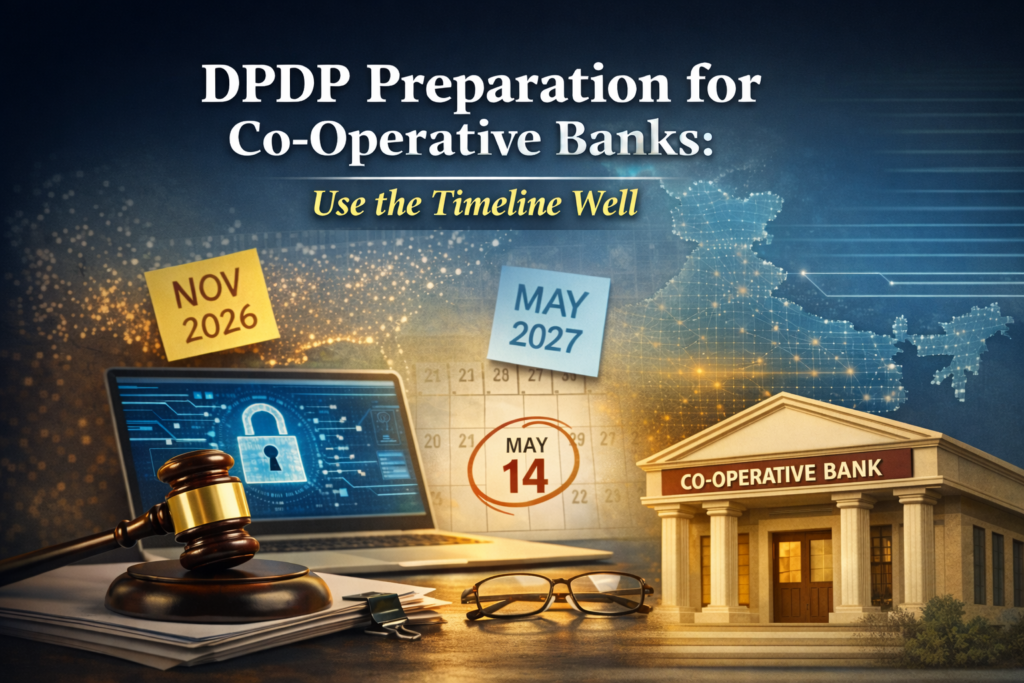
Data Privacy • Co-Operative Banking • DPDP Readiness DPDP Preparation for Co-Operative Banks: Use the Timeline Well For co-operative banks, the present period should be treated as working time. The law is in place, the commencement dates are known, and the institutions that use this window properly will be in a far stronger position than those that leave the exercise for the end. By Ashish Vilas Sonawane Advocate | Founder, Nyaya Niti Strategic Legal Consultancy LLP For co-operative banks, data privacy should now be treated as a live implementation subject. The Digital Personal Data Protection Act, 2023 is already in force as the governing statute. The Digital Personal Data Protection Rules, 2025 were notified in November 2025, and their commencement is staggered. Under Rule 1, Rules 1, 2 and 17 to 21 came into force on publication, Rule 4 is to come into force one year later, and Rules 3, 5 to 16, 22 and 23 are to come into force eighteen months after publication. For institutions that handle personal data every day, this period should be used for preparation. 14 November 2025 The Rules were notified. Rules 1, 2 and 17 to 21 came into force on publication. 14 November 2026 Rule 4 is to come into force one year after publication. 14 May 2027 Rules 3, 5 to 16, 22 and 23 are to come into force eighteen months after publication. Why this period matters In most institutions, privacy risk does not arise from one dramatic error. It arises because records, systems, vendors, archived files, and internal responsibility have grown over time without one clear view. The law may be new, but the records are already there. A co-operative bank does not deal with personal data in one narrow compartment. It handles account opening records, KYC documents, loan papers, nominee and guarantor details, employee records, CCTV footage, recovery files, customer communication, and digital banking information. Some of this sits with branches. Some of it remains within internal departments. Some of it moves through software systems, archived records, and outside service providers. The DPDP Act applies to digital personal data, including personal data collected offline and later digitised. In the banking context, that gives the subject a wider operational reach than many institutions may initially assume. Banking regulation has, of course, never ignored confidentiality. RBI’s outsourcing framework has long required banks to retain control over outsourced functions, preserve customer confidentiality, and ensure that records remain available in line with legal and regulatory requirements. DPDP does not replace that discipline. It adds another layer to it. The subject is no longer confined to secrecy, cyber-security, or system access. It now also concerns notice, processing, grievance handling, and retention in a more structured statutory setting. For co-operative banks, this is less a drafting exercise and more an exercise in bringing records, systems, documents, vendors, and responsibility into one order. What the timeline means The period up to 14 November 2026 should be used to understand the bank’s own record position and to correct the documents and systems through which personal data is handled. The period up to 14 May 2027 should be used to ensure that the revised structure is actually working in practice. These are not dates to be merely noted in a compliance calendar. They divide the preparation window into two practical stages. The difficulty in this area is usually not in reading the law. It is in understanding the institution’s own records, systems, vendors, and internal responsibility. In many co-operative banks, information is not held under one control point. One part remains with operations, another with technology systems, another with HR, another with recovery, and another with outside processors. Until this position is examined properly, privacy compliance remains incomplete even if a policy has already been drafted. Before November 2026 The first part of the work is foundational. The bank should identify what personal data it holds, where it is stored, through which systems it moves, which departments use it, which outside vendors handle it, and why it is being retained. This review should not stop with customer onboarding. It should extend to nominee and guarantor records, employee files, recovery documentation, archived scans, CCTV, website forms, app interfaces, customer support records, and information handled by technology and service vendors. If that internal picture is unclear, later corrections tend to remain partial. Once the records and flows are understood, the documents should be reviewed together. Customer-facing forms, declarations, privacy notices, app permissions, employee documents, and vendor contracts should not be looked at in isolation. They must reflect the same position. If the form says one thing, the system does another, and the vendor arrangement permits something wider, the gap will remain. This is also the stage at which vendor arrangements should be looked at carefully. A number of co-operative banks rely on outside providers for core systems, messaging, support services, scan-and-store functions, and customer communication tools. Existing agreements may contain broad confidentiality wording, but that by itself is not enough. Access, escalation, retention, post-termination handling, and record control should also be checked. RBI’s outsourcing framework is directly relevant here because it already places continuing responsibility on the bank in relation to outsourced functions and customer information. Before May 2027 The second part of the work is about making sure the revised system actually functions. By the time the wider set of Rules becomes operative on 14 May 2027, the bank should not still be deciding where requests will be received, who will route them, which records may be corrected, which must be retained, and how a vendor-side issue will be handled. By that stage, branches should know when a matter has to be escalated. Central teams should know where the relevant record sits. Vendor-side obligations should be capable of enforcement in practice. Senior management should know which parts of the institution are in order and which still require correction. The practical difference Institutions that begin early will have time to correct forms, systems, and contracts carefully. Institutions that

DPDP Preparation for Co-Operative Banks Read More »

Banking

Neurotechnology, Law, and the Limits of Intrusion

Technology Law Neurotechnology, Law, and the Limits of Intrusion By Adv. Ashish Sonawane Neurotechnology is usually discussed in the language of promise. It is associated with rehabilitation, assistive communication, brain-computer interfaces, and new possibilities for those living with paralysis, epilepsy, depression, and other serious conditions. That promise is real and should not be dismissed. UNESCO has itself recognised both the therapeutic value of neurotechnology and the ethical risks it may pose to dignity, autonomy, freedom of thought, and mental privacy. Its legal significance, however, lies not only in treatment, but in the kind of access it may claim over the human mind. Most technologies engage the body, communication, property, or ordinary personal data. Neurotechnology raises a more difficult legal issue. It concerns technologies that claim the capacity to access, infer, influence, or decode aspects of brain activity and mental states. Once the law enters that terrain, the issue is no longer confined to consumer protection or routine data processing. It begins to concern agency, dignity, and liberty at a deeper level. UNESCO’s neurotechnology framework expressly identifies risks relating to personal identity, autonomy, mental privacy, and freedom of thought. For that reason, neurotechnology cannot be treated merely as another health-tech issue. It lies at the intersection of constitutional liberty, medical ethics, informational privacy, AI governance, product liability, and human rights. If law responds too late, the consequences will not remain technical for long. That is a reasonable inference from the manner in which international institutions are already approaching the field. Its legal significance lies not only in treatment, but in the kind of access it may claim over the human mind. Why neurotechnology is legally different The law is familiar with bodily integrity. It knows how to deal with assault, medical consent, unlawful search, medical negligence, and invasive procedures. Neurotechnology narrows the distance between bodily intervention and mental intrusion. In legal terms, that distinction is critical. A device that records pulse or movement is one thing. A technology that claims to read patterns of cognition, infer intention, classify emotional states, or alter neural response is another. UNESCO has specifically warned that neurotechnology may reveal personal information about identity, emotions, and thoughts, and that AI-linked systems may deepen these risks. To treat this only as a data-governance issue would be too narrow. Neural data may indeed be data in one sense. It may be collected, stored, transferred, or processed. But that does not exhaust the legal problem. The deeper concern is intrusion into a sphere that constitutional democracies have traditionally treated with special care: the protected realm of thought, choice, and self-determination. Indian privacy doctrine, too, has recognised the body and the mind as inseparable elements of human personality. Indian constitutional law is not silent on this concern India does not yet have a direct ruling on neurotechnology governance in its present commercial or clinical form. Even so, the Constitution is not silent on the underlying concerns. In Selvi v. State of Karnataka (2010), while dealing with involuntary narco-analysis, polygraph examination, and the Brain Electrical Activation Profile test, the Supreme Court expressly referred to the subject’s right to privacy “both in a physical and mental sense.” The Court also examined the issue through the lens of personal liberty, self-incrimination, and protection against cruel, inhuman, or degrading treatment. That was not a neurotechnology regulatory case in the modern sense, but its reasoning is directly relevant here. It shows that Indian constitutional law has already recognised that compelled intrusion into mental processes raises concerns different from ordinary physical evidence-gathering. A second important constitutional reference point is K.S. Puttaswamy v. Union of India (2017). The privacy judgment did not concern neurotechnology specifically, but it located privacy within dignity, liberty, and constitutional personhood. Justice Chandrachud’s opinion observed that privacy allows each human being to be left alone in a core “which is inviolable” and that courts must remain sensitive to the opportunities and dangers posed to liberty in a digital world. That reasoning bears directly on this issue. The linkage becomes even sharper in V. Vasanta Mogli v. State of Telangana (2023). Drawing on privacy doctrine, the Telangana High Court observed that the body and the mind are inseparable elements of human personality, that privacy enables autonomy of both body and mind, and that the intersection between mental integrity and privacy entitles the individual to freedom of thought and self-determination. That language is especially useful here because it gives constitutional form to concerns now described internationally as mental privacy, cognitive liberty, and mental integrity. So while Indian courts have not yet framed a standalone doctrine of neurorights, the underlying constitutional principles are already available. Consent remains essential, but it cannot do all the legal work here One weakness of modern technology regulation is the tendency to place excessive weight on formal consent. A signed form, a checkbox, or a privacy notice is often treated as if it resolves the deeper legal problem. In the context of neurotechnology, that would be insufficient. An individual may not fully understand downstream inference risks. The science itself is still evolving. And in many settings, the imbalance of power will be structural rather than incidental. That concern becomes sharper in employment, insurance, education, defence, or custodial contexts, where agreement may exist in form without being fully voluntary in substance. UNESCO’s ethics materials move well beyond mere notice-and-consent language and emphasise misuse prevention, protection of mental privacy, and effective safeguards. A serious legal framework for neurotechnology will therefore require more than disclosure language. It will require purpose limitation, restrictions on coercive deployment, heightened standards for research and clinical use, safeguards against secondary use, meaningful redress, and, in some cases, categorical limits. That is a normative conclusion, but it follows from the nature of the interests involved and from the direction in which current international governance thinking is moving. The greater danger may lie in gradual normalisation The greater danger may lie not in immediate abuse, but in gradual normalisation. It would be unsafe to assume that neurotechnology will remain limited to

Neurotechnology, Law, and the Limits of Intrusion Read More »

Beyond the Courtroom: Strategic Legal Solutions for Modern Businesses

When we hear the words “law” or “legal,” many of us think about courtrooms, judges with gavels, and lawyers arguing. But nowadays, legal work is about much more than just going to court. For businesses especially, the law plays a bigger role outside the courtroom. In fact, getting the right legal advice can help companies stay out of legal trouble in the first place. Let’s look at how today’s businesses use smart legal help to grow, stay safe, and succeed. What Is “Strategic Legal Solutions”? Legal issues aren’t always about crimes or going to court. In business, the law is part of almost everything like starting a business, making deals, managing workers, and protecting your company name. Using legal help in a smart way means not waiting for problems to happen. It means planning ahead, avoiding trouble, and making better choices with legal advice. Think of it like this: A doctor doesn’t only treat you when you’re sick they also help you stay healthy. In the same way, a good business lawyer doesn’t just fix problems — they help you avoid them in the first place. Why Do Modern Businesses Need Legal Strategy? Today’s business world moves very fast and has many rules. Even a small mistake like not checking a contract properly  can cost a company a lot of money. That’s why companies need lawyers who understand business, not just those who fight in court. Here’s why having a legal plan matters: Saving Money by Avoiding Court Cases Going to court takes a lot of time and money. One case can drag on for years and cost lakhs or even crores. Smart companies use lawyers to fix problems early, before they become court cases. Example: Instead of fighting over a contract later, a lawyer can help write a clear and fair one from the start. Following the Rules (Compliance) Every business has to follow rules like tax laws, labor rules, and environmental laws. If they don’t, the government can fine them or even close the business. Lawyers help businesses understand these rules so they don’t face unexpected trouble. Protecting Ideas and Brands (Intellectual Property) Today, companies don’t just sell products they also sell ideas, names, logos, designs, and software. These are called intellectual property (IP). Lawyers help register these things as trademarks, copyrights, or patents so no one else can copy them. Managing Staff and HR Problems Things like hiring, firing, salaries, or harassment issues need to be handled carefully. One wrong move can cause big legal issues. Lawyers help companies make proper rules for staff and handle problems in a fair and legal way. Common Strategic Legal Areas for Businesses Let’s look at the main ways businesses use legal help:  Contracts and Agreements Whether a company is hiring someone or making a deal with a supplier, contracts are important. A business lawyer checks that the contract is easy to understand, fair, and protects the company. They make sure there are no hidden rules that could cause problems later.  Mergers and Acquisitions (M&A) When one company buys or joins with another, it’s called a merger or acquisition. These deals involve a lot of papers, money, and possible risks. Lawyers help make sure everything is legal and all documents are correct.  Data Protection and Privacy Today, customer data is very valuable. But businesses must keep it safe. Legal experts help set rules that follow data privacy laws, like GDPR in Europe or India’s new data law.  Solving Disputes Without Court Sometimes, businesses have disagreements. Instead of going to court, lawyers help solve the issue through talking, mediation, or other peaceful ways. This saves time, money, and keeps good relations between people. Small Businesses Need Legal Strategy Too You don’t need to be a big company like Tata or Infosys to need legal support. Even small business owners, startup founders, or online sellers deal with legal matters in their daily work. For example: A bakery wants to keep its brand name safe. A YouTuber wants to stay away from copyright problems. A freelancer needs a clear agreement with a client. A home-based business wants to get a GST registration. All these people just need easy and useful legal guidance.   How Can You Get Strategic Legal Help? How businesses can start using legal help:  Talk to a Business Lawyer Find a lawyer who knows about business. Many offer special plans for new companies or monthly help. Check Contracts First Before signing any important papers, ask a lawyer to look at them.  Keep Up with New Laws Rules can change. Get updates or ask a legal expert, especially about taxes, workers’ rights, and data privacy.  Make Company Rules Create simple rules for your team about safety, behavior, and daily work. This lowers risk and shows your company is serious.  Teach Your Team Give basic legal training so employees don’t make mistakes that could cause legal problems. Real-Life Example: How One Startup Saved Itself A small tech startup in Delhi made a useful app and launched it quickly. But they forgot to register their brand name and didn’t make proper agreements with their employees. A few months later, someone who used to work there copied their idea and made a similar app. Since the company didn’t have strong legal documents or protection for their idea, they had a hard time dealing with the issue. Later, they hired a legal expert and: Registered their brand name (trademark) Created proper contracts for employees Set rules to protect company data Now, they run their business more smartly and safely, with less chance of legal trouble. Legal Strategy = Business Strategy Earlier, people only looked for legal help during serious problems. But now, it’s become an important part of running a business wisely. Just like you need marketing to grow or finance to handle money, you also need legal support to keep your business safe and on the right track. No matter if your business is big or small, getting legal advice early can help you

Beyond the Courtroom: Strategic Legal Solutions for Modern Businesses Read More »

Criminal Law Today: From Online Crimes to Office Crimes

The world has changed a lot, and so has the way people do bad things. Now that we use phones, computers, and the internet all the time, people can do bad things in new ways. The rules that punish people who break the law called criminal law have also changed to deal with these new kinds of crimes. What is Criminal Law? Criminal law is a part of the law that deals with people who do wrong things, like stealing, hurting others, or breaking into places. If someone breaks the law, the government punishes them. This can mean going to jail or paying money. In the past, most crimes were done in person, like robbing a house or fighting someone. But now, some crimes are done using the internet. People don’t even need to meet each other to do these bad things. What is Cybercrime? Cybercrime means doing bad things using a computer, phone, or the internet. Here are some examples: Hacking: Getting into someone’s computer or account without asking. Phishing: Sending fake emails to trick people into giving their passwords or bank details. Online cheating: Lying to people online to take their money. Cyberbullying: Saying mean or scary things to someone online. These crimes can hurt people a lot. A hacker can steal your name and use it to open a bank account. Cyberbullying can make people feel very sad. Big companies and even governments can also be harmed by these crimes. Governments have made special teams to stop online crimes. But it’s not easy because criminals can hide online and live in other countries. What is White-Collar Crime ? White-collar crime means crimes done by people who work in offices or businesses. These crimes don’t use violence, but they include lying, cheating, or stealing money. Here are some examples: Fraud: Lying to get money, like faking an insurance paper or lying in business. Office stealing:: Taking money from your workplace. Insider trading: Using secret business information to earn money in the stock market. Money laundering: Hiding where illegal money came from. These crimes can affect many people and cause a lot of money to be lost. Sometimes they go unnoticed for a long time. But if the person is caught, they can be fined a lot of money or go to jail. Police and law workers now use computers and experts to find these types of crimes. Problems with Modern Criminal Law Technology changes fast: New apps and websites come out often. Criminals use these new tools before the law can stop them. Crimes happen in many countries: A person can be in one country and steal from someone in another. This makes it hard to catch them. Countries need to work together to stop these crimes. Some crimes are hard to understand: Crimes using computers or money tricks can be very confusing. Police, lawyers, and judges need to learn special skills to understand and stop them. In Conclusion Criminal law is meant to keep people safe by punishing those who do wrong things. But crime has changed. Now we have cybercrime and white-collar crime,which can cause a lot of harm. The law is getting better, but it needs to keep improving. Police, government workers, and law experts must work together. And all of us must be careful, especially when using the internet. By learning about these crimes, we can help keep ourselves and our world safer  

Criminal Law Today: From Online Crimes to Office Crimes Read More »

Evolving Landscape of Legal Consulting: Integrating Technology and Innovation in 2025

The legal world is changing. In 2025, legal consultancy is not just about lawyers in suits and big offices. Today, technology is helping law firms work faster, smarter, and better. From AI in law to cloud tools and stronger online security, the way lawyers work is becoming more modern. This change is helping both legal professionals and the people they serve. In this blog, we’ll explain how legal services are evolving in simple, easy-to-understand language. If you’re new to this topic or not from a legal background don’t worry. We’ll keep it clear, friendly, and useful. 1. Data-Driven Decision Making in Legal Services In the past, lawyers mostly used books, memory, and experience to make decisions. Now, they use data facts, numbers, and patterns to help guide their legal advice. What does that mean?Imagine a lawyer handling a case about online fraud. Instead of guessing, they can now look at thousands of similar past cases using special software. This helps them predict what might happen and build a stronger case.This makes legal decisions more accurate and fair. Clients get better outcomes. Law firms also save time. Legal technology makes all this possible by collecting and analyzing large amounts of data. 2. Personalized Client Experiences Through Legal Technology Today’s clients want services that match their needs. Legal firms are using technology to offer personalized experiences. What does that mean?Think of using an app to get medical help. Now imagine something similar for legal help. You answer a few questions, and the system shows the best type of legal support for you. It might even connect you to the right lawyer. This is called legal consultation through technology, and it’s becoming common in law firm services and legal startups.It saves time, feels more personal, and helps people get legal advice quickly even from home. 3. Automation of Routine Legal Tasks Many legal tasks are boring and repetitive. These include filling out forms, checking documents, or organizing files. Today, these jobs are being handled by automation smart software that does tasks automatically. Software can now write simple letters, book meetings, or find information in legal files. Lawyers don’t have to do everything themselves.  Automation saves time and reduces mistakes. Lawyers can focus on giving good legal advice, not paperwork. Clients get faster service. 4. Prioritizing Cybersecurity in Legal Services In 2025, a lot of legal work will be done online. This means that cybersecurity protecting online data is more important than ever. Lawyers keep sensitive information like names, addresses, and legal documents. If this information is not protected, hackers can steal it. That’s why law firms now use strong passwords, secure servers, and cybersecurity law tools to protect client data. Clients must trust that their personal and legal information is safe. By focusing on cybersecurity, law firms build that trust and also follow the rules of cyber law. 5. The Rise of AI in Legal Consulting One of the biggest changes in legal consultancy is the use of AI (Artificial Intelligence). AI is smart software that can “learn” and do tasks that usually need human thinking. AI can read thousands of legal documents in seconds. It can find the right law for your problem or even suggest how to solve it. For example, if someone wants to know how to handle a property dispute, AI in law tools can quickly provide possible answers, based on thousands of past cases.  Artificial intelligence legal tools make legal services faster, cheaper, and more accurate. Lawyers still play an important role but AI helps them work smarter. 6. Cloud-Based Legal Practice Management Legal firms are also using the cloud system to store files online. This means they don’t need to keep everything in paper files or office computers.Lawyers can access case files from anywhere home, office, or even while traveling. Clients can also upload documents and check updates online. This system is called cloud-based legal practice management.  It makes work easier and more organized. Legal startups and small law firms benefit a lot from this low-cost, high-efficiency system. Conclusion: Embrace Innovation or Fall Behind The world is moving fast. So is the legal industry. New crimes, like online scams and digital identity theft, need new solutions. Old methods of legal work can no longer keep up. To stay helpful and successful, law firms and legal consultants must adopt legal technology, AI tools, cloud systems, and strong cybersecurity. These innovations help deliver faster, safer, and more effective legal advice. If you’re a lawyer, legal startup, or client now is the time to embrace the change. If you don’t, you risk falling behind. In Summary: Case Study A small law office in Jaipur was having a tough time. They were using paper files, doing all the work by hand, and taking a lot of time to reply to their clients. The lawyers were always busy, tired, and still not able to keep up. Clients had to wait a lot, and things often got messy. So, they decided to change the way they worked. They started keeping all their files online so they could open them anytime, from anywhere. They used smart tools to find old cases and laws quickly instead of reading big books for hours. Simple jobs like sending emails, booking meetings, and filling forms were done by software. They also made a safe online space where clients could send their documents and see updates about their case. To keep everything safe, they used strong passwords and secure storage. After a few months, everything became smoother. The lawyers were less stressed, and the clients were happy because they got faster service. More people started coming to them. This shows that even a small law office can do better and grow if it uses the right technology in simple ways.

Evolving Landscape of Legal Consulting: Integrating Technology and Innovation in 2025 Read More »

DISCLAIMER & CONFIRMATION
As per the rules of the Bar Council of India, Law Firms are not permitted to solicit work and advertise. By clicking the "I Agree" button, you acknowledge and accept the following:
There has been no advertisement, personal communication, solicitation, invitation or inducement of any sort whatsoever from us or any of our members to solicit any work through this website;
• Your wish to gain more information about us for your own information and use;
• The information about us is provided to you only on your specific request and any information obtained or materials downloaded from this website are completely at your volition.
• Any transmission, receipt or use of this site would not create any lawyer-client relationship.
Though the firm has taken utmost care in the preparation of the website, the information contained herein is not intended to constitute any legal advice and the firm cannot accept any legal responsibility towards those who rely solely on the contents of the website. The firm does not claim that the information provided is accurate, complete and up to date. Further, the materials and links to third party websites provided herein are for information purposes only. The firm makes no representations or warranties, express or implied, with respect to the information provided on any third party website which may be accessed by any link from this website.

Scroll to Top